

How to Choose the Best Hybrid Solar Inverter for Dubai Villas in High Heat Conditions
September 1, 2026
Top 10 Best Hybrid Solar Inverters in MEA: Maxell Power Features, Efficiency & Specs
September 9, 2026Best Lithium Batteries for UAE Homes Complete Solar Energy Storage Guide & Price Range (2026)
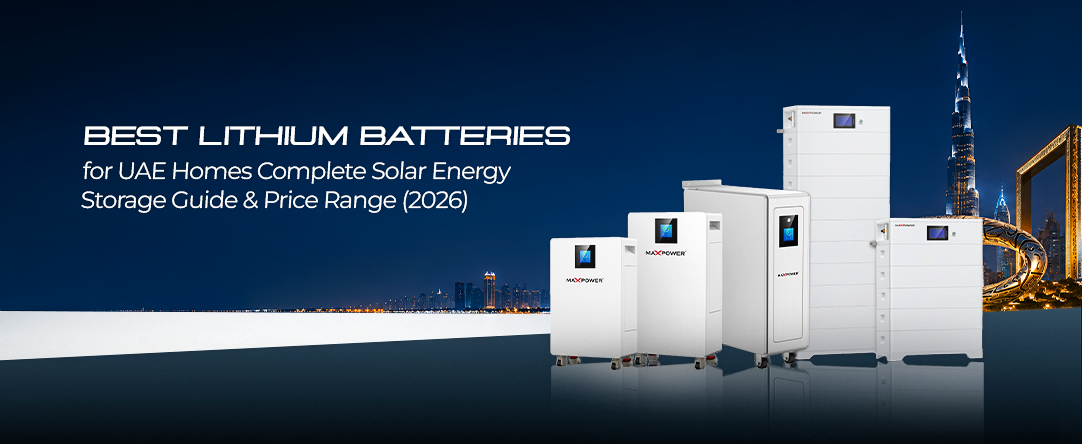
With year-round sunshine across Dubai, Abu Dhabi, Sharjah, and the Northern Emirates, solar energy has become an increasingly popular solution for UAE homeowners and property managers. Solar panels can generate significant amounts of electricity during the day, but without a battery storage system, much of that energy may not be available after sunset. This is why choosing the best lithium batteries for UAE homes has become an important consideration for homeowners looking to improve energy independence and make better use of their solar investment.
The UAE climate also makes battery selection particularly important. Summer temperatures can exceed 45°C, while enclosed garages, rooftops, and poorly ventilated areas can become even hotter. A residential battery therefore needs to provide reliable performance under demanding environmental conditions. In addition to capacity, homeowners should consider battery chemistry, thermal performance, Battery Management System (BMS), inverter compatibility, cycle life, enclosure protection, warranty, and installation requirements.
In this complete 2026 guide, we explain how lithium batteries work with residential solar systems, what homeowners should look for when choosing a battery, the typical lithium battery price in UAE, and how to determine the right storage capacity for a villa or residential property.
Why Lithium Iron Phosphate (LiFePO₄) Batteries Are Ideal for UAE Homes
Lithium Iron Phosphate, commonly known as LiFePO₄, has become one of the most popular lithium battery chemistries for residential solar energy storage. Its combination of long cycle life, high usable capacity, strong chemical stability, and relatively low maintenance makes it particularly suitable for homeowners who want to use battery storage on a daily basis.
One of the biggest advantages of LiFePO₄ technology is its thermal and chemical stability. This is especially relevant in the UAE, where high temperatures can place additional stress on energy storage equipment. However, battery temperature ratings still vary between manufacturers, so homeowners should always check the recommended operating and charging temperatures before installation.
LiFePO4 batteries can also provide a high depth of discharge, allowing homeowners to use a significant portion of the battery’s stored energy. When combined with an appropriate solar inverter and correctly configured Battery Management System, this can make lithium storage an efficient option for storing excess daytime solar production and using it during evening and nighttime hours.
Another major advantage is cycle life. High-quality LiFePO4 batteries can provide thousands of charge and discharge cycles when operated within the manufacturer’s recommended conditions. This makes them particularly attractive for residential solar systems where the battery may be charged and discharged almost every day.
For homeowners planning a complete solar energy system, combining battery storage with a suitable hybrid solar inverter can provide better control over solar generation, household consumption, battery charging, and grid electricity.
Lithium Battery Price in UAE in 2026
The lithium battery price in UAE depends on several factors, including storage capacity, battery chemistry, voltage, BMS technology, cycle life, inverter compatibility, warranty, brand, and installation requirements. Residential lithium battery systems can generally range from around AED 3,500 to AED 25,000 or more depending on the size and configuration of the system.
For smaller homes and backup applications, a 5kWh lithium battery can be a practical starting point. These batteries are suitable for storing solar energy and supporting essential household appliances such as lighting, refrigeration, networking equipment, and selected electrical loads. Depending on the manufacturer and specifications, 5kWh-class lithium batteries may typically cost around AED 2,300 to AED 3,500.
For larger villas, a 10kWh to 16kWh battery system may provide significantly more usable energy for evening consumption. These systems can support larger household loads and can be expanded in some configurations as electricity requirements increase. Products such as the MP-16000 Ultra Lithium Battery are designed for higher-capacity energy storage applications and can be considered by homeowners looking for a larger residential storage solution.
High-voltage lithium battery systems are also available for large villas, commercial properties, and applications with higher electricity requirements. Depending on capacity, voltage configuration, inverter compatibility, installation requirements, and other specifications, these systems can cost approximately AED 12,000 to AED 25,000 or more.
Because battery prices can change according to brand, availability, exchange rates, installation requirements, and system configuration, homeowners should request a current quotation before making a purchasing decision.
How Much Battery Storage Does a UAE Villa Need?
The right battery size depends on how much electricity your property consumes and which appliances you want to operate after sunset. A homeowner who only wants backup power for essential appliances will require considerably less storage than a large villa owner who wants to operate air conditioning, refrigeration, lighting, entertainment systems, and other appliances throughout the night.
A 5kWh battery may be suitable for essential backup or smaller residential properties, while a 10kWh to 15kWh system can provide greater flexibility for medium-sized villas. Larger properties with significant air-conditioning loads may require 20kWh or more depending on their energy consumption and backup objectives.
The best way to determine the correct battery capacity is to review your actual electricity usage rather than selecting a battery based only on the size of your solar panel system. Your nighttime electricity consumption, peak loads, solar generation, desired backup duration, and inverter capacity should all be considered before purchasing a battery.
Important Features to Check Before Buying a Lithium Battery
One of the most important features to consider is the Battery Management System (BMS). A quality BMS continuously monitors battery conditions and helps protect the cells from problems such as overcharging, excessive discharge, abnormal temperature, and voltage imbalance. Smart BMS technology can also communicate with compatible solar inverters, allowing the complete energy-storage system to operate more efficiently.
Inverter compatibility is another critical consideration. Before purchasing a lithium battery, homeowners should confirm that the battery can communicate correctly with their existing or planned inverter. Common communication protocols include CAN and RS485, although compatibility depends on the specific manufacturers and models. Choosing an incompatible battery can lead to communication problems and prevent the system from operating correctly.
The battery’s usable capacity should also be considered. A battery advertised as 10kWh does not necessarily mean that the homeowner can continuously use the full 10kWh. The recommended depth of discharge, reserve capacity, system efficiency, and manufacturer’s operating limits can affect the amount of energy that is actually available.
Temperature performance is particularly important for UAE installations. Homeowners should check the battery’s operating temperature range, charging temperature limits, thermal protection, and installation requirements. A battery should not be installed in an excessively hot location simply because it has a high temperature rating. Proper ventilation, shading, and compliance with the manufacturer’s installation instructions remain essential.
The enclosure rating should also match the installation environment. Batteries installed in areas exposed to dust or moisture may require appropriate protection against environmental conditions. However, homeowners should always follow the manufacturer’s instructions rather than selecting an IP rating based only on the number.
Where Should You Install a Lithium Battery in Dubai?
Battery location can have a significant effect on long-term performance. In the UAE, lithium batteries should generally be installed in a suitable shaded, dry, and adequately ventilated location that meets the manufacturer’s requirements. Direct exposure to intense sunlight should be avoided unless the battery has specifically been designed and approved for outdoor installation.
Suitable locations may include dedicated utility rooms, battery rooms, or appropriate garages where temperature, ventilation, dust exposure, and moisture can be controlled. Before installation, the available wall or floor space should also be checked to ensure that the battery can be installed safely and accessed for inspection or maintenance.
For outdoor installations, homeowners should carefully check the manufacturer’s temperature limits, enclosure rating, weather protection requirements, and ventilation recommendations. Professional installation is recommended to ensure the battery, inverter, protection equipment, and electrical connections are correctly configured.
Lithium vs Lead-Acid Batteries for UAE Solar Systems
Lithium batteries generally offer several advantages over traditional lead-acid and gel batteries for residential solar applications. LiFePO4 batteries typically provide greater usable capacity, faster charging, longer cycle life, higher energy density, and lower maintenance requirements.
Lead-acid batteries can have a lower initial purchase price, which may make them attractive for certain backup applications. However, they are generally heavier and may require more maintenance while also offering a lower usable depth of discharge. For homeowners who intend to cycle their battery regularly with solar energy, lithium technology can offer better long-term value depending on the system design and purchase price.
The final choice should therefore be based on the property’s energy requirements, budget, expected cycling frequency, available installation space, and desired system lifespan.
Can Lithium Batteries Help Reduce Grid Dependence?
A properly designed solar-plus-storage system can help UAE homeowners use more of the solar energy they generate during the day. Instead of relying entirely on grid electricity after sunset, excess solar production can be stored in the battery and used later when household demand increases.
This can be particularly useful for homes with high evening electricity consumption. During the day, solar panels generate electricity that can power household appliances while also charging the battery. After sunset, the stored energy can then be used to supply selected household loads.
The actual savings and level of grid independence depend on solar system size, battery capacity, household consumption, electricity tariffs, inverter configuration, and daily energy usage. A professional energy assessment can help determine whether adding battery storage makes financial and technical sense for a particular property.
Battery Storage for Solar Water Pumping
Lithium batteries can also form part of specialized solar energy systems where stored power is required for applications such as water pumping and irrigation. Properties with agricultural, landscaping, or water-management requirements can combine suitable solar generation, battery storage, and a dedicated solar pumping inverter to manage pumping operations.
The correct configuration depends on the pump’s power rating, operating schedule, required water flow, solar generation, and battery capacity. For these applications, the system should be professionally designed so that the battery and inverter can safely handle the required electrical load.
How to Choose the Best Lithium Battery for Your UAE Home
Choosing the best lithium battery for a UAE home ultimately comes down to matching the battery to the property’s actual energy requirements. Instead of choosing a battery only because it has a high kWh rating or low price, homeowners should evaluate usable capacity, cycle life, BMS protection, temperature performance, inverter compatibility, enclosure protection, warranty, and after-sales support.
It is also important to consider future energy requirements. If you plan to add additional air conditioning, electric vehicles, appliances, or other high-power equipment, a modular battery system may provide greater flexibility because additional storage can potentially be added later.
A reliable supplier should also be able to provide technical guidance on battery sizing, inverter compatibility, installation requirements, warranty coverage, and system configuration. This can help prevent costly compatibility problems and ensure that the energy-storage system performs as expected.
Final Thoughts
Choosing the right lithium battery for a UAE home in 2026 requires careful consideration of both technical specifications and local climate conditions. LiFePO4 batteries are an attractive option for residential solar systems because they offer long cycle life, high usable capacity, strong thermal stability, and relatively low maintenance.
However, battery capacity should always be selected according to actual household electricity consumption. A 10kWh battery may be sufficient for one property but inadequate for another, especially when multiple air-conditioning systems and other high-power appliances are operating overnight.
Before purchasing, compare the battery’s usable capacity, BMS protection, temperature ratings, cycle life, inverter compatibility, enclosure protection, warranty, and local technical support. For homeowners planning a complete solar energy solution, exploring suitable hybrid solar inverter solutions and lithium battery systems can be a useful starting point.
Frequently Asked Questions
What is the average lifespan of a lithium solar battery in the UAE?
A quality LiFePO4 battery can provide many years of service when it is correctly sized, installed, and operated within the manufacturer’s recommended conditions. Actual lifespan depends on factors such as temperature, depth of discharge, charging conditions, cycling frequency, and overall system management.
How many kWh of battery storage does a UAE villa need?
Many UAE villas may benefit from approximately 10kWh to 20kWh or more of storage, but the correct capacity depends on actual electricity consumption. Homes with high air-conditioning usage may require substantially more storage than properties that only need essential backup power.
Can lithium solar batteries be installed outdoors in Dubai?
Some lithium batteries are specifically designed for outdoor installation, while others are intended for protected indoor environments. Always check the manufacturer’s temperature, IP rating, ventilation, and installation requirements before installing a battery outdoors.
Are LiFePO4 batteries safer than traditional lead-acid batteries?
LiFePO4 batteries are known for strong thermal and chemical stability and are widely used in residential energy-storage systems. Modern lithium batteries also include Battery Management Systems that monitor important operating conditions and provide protective functions.
What is the price of a 10kWh lithium solar battery in Dubai?
The price varies depending on battery brand, chemistry, BMS, warranty, cycle rating, inverter compatibility, installation, and configuration. As a general 2026 guide, residential systems in the 10kWh to 16kWh range may fall around AED 5,500 to AED 9,000, although current supplier pricing should always be confirmed before purchasing.
