
Complete Solar Product Ranges for Trade and Residential Needs Across MEA
June 17, 2026
Deye vs Maxell Power: Which Solar Inverter and Battery Solutions Are Better for Iraq and Afghanistan?
June 30, 2026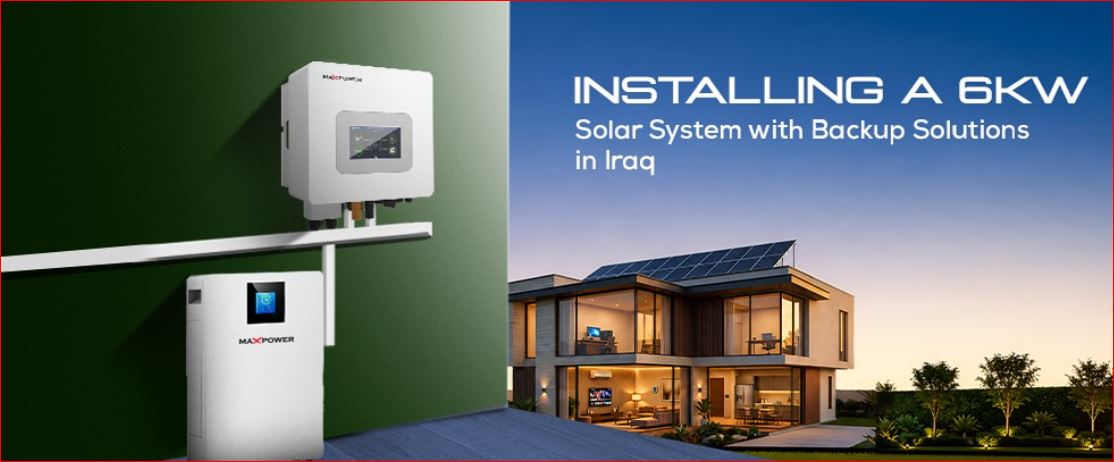
Iraq’s energy situation in 2026 is one of the most acute in the Middle East. Baghdad, Basra, Mosul, and virtually every Iraqi city continue to experience daily scheduled and unscheduled power outages, often exceeding 12 hours per day during peak summer months when temperatures exceed 48°C and cooling loads are at their highest. Diesel generators remain widespread, with Iraqi households and businesses spending substantially on fuel to bridge the gap between what the national grid delivers and what daily life requires.
The solar and storage solution market in Iraq has responded significantly. In the first quarter of 2025 alone, more than 6,000 inverters were exported to the Iraqi market for residential and commercial applications. Solar panels, hybrid inverters, and LiFePO4 battery banks are now the dominant long-term alternative to generator dependency across Iraqi cities and increasingly in rural areas.
A 6 kW solar system with battery backup is the most common residential and small commercial configuration being installed in Iraq in 2026. This guide covers how to size and specify it correctly for Iraqi conditions.
Understanding Iraq’s Solar Energy Profile
Iraq receives an average of 6 to 7 peak sun hours per day across most of the country, making it one of the highest solar resource markets in the Middle East. Baghdad receives approximately 6.2 peak sun hours annually. Basra, with its desert climate, averages even higher. This resource profile means a correctly sized 6 kW system in Iraq generates between 33 and 42 kWh per day under normal operating conditions.
Against a typical Iraqi household daily consumption of 20 to 30 kWh, a 6 kW solar system can offset the majority of daytime consumption while charging a battery bank for evening and overnight use during grid outages.
Sizing the System: Panels, Inverter, and Battery
Panel Array
For a 6 kW system in Iraq, a standard configuration is 10 to 12 monocrystalline panels at 550W to 600W each, producing 5,500W to 7,200W of DC capacity. The slight oversizing above the 6 kW inverter rating is intentional. Iraq’s summer temperatures cause panels to lose 15% to 18% of rated output from thermal derating at 50°C cell temperatures. Oversizing the panel array by 20% to 30% compensates for this loss and ensures the inverter operates at rated output during the morning and late afternoon shoulder hours when temperatures are lower.
Maxell Power’s solar panel range includes high-efficiency monocrystalline panels specified for operation in high-temperature desert conditions relevant to Iraq’s climate.
Hybrid Inverter Selection
Iraq’s grid, when available, delivers unstable voltage and frequency in many distribution areas. The hybrid inverter must handle wide input voltage variation without unnecessary switching to battery mode. Maxell Power’s hybrid solar inverter range includes units with AC input voltage tolerance from 90V to 280V, covering the grid fluctuation patterns common in Iraqi distribution networks.
For a 6 kW system, a single-phase 6 kW to 8 kW hybrid inverter with dual MPPT trackers handles the 10 to 12 panel string configuration and manages simultaneous solar generation, battery charging, and grid backup with a 10 ms transfer time for seamless outage switching.
Battery Bank for Iraqi Outage Patterns
Iraq’s daily outage windows during summer often extend to 12 hours or more. For a family home running air conditioning, refrigeration, lighting, and basic electronics through a 10-hour outage window at an average load of 2 kW to 3 kW, the battery bank needs to deliver 20 to 30 kWh of usable energy.
At 80% usable depth with LiFePO4 chemistry, this requires 25 to 37 kWh of rated battery capacity. For most Iraqi residential installations, this means a battery bank configuration using multiple lithium units from Maxell Power’s lithium battery range, connected in parallel to achieve the required capacity.
For Iraqi installations where summer ambient temperatures in utility rooms routinely exceed 45°C, LiFePO4 chemistry is specifically chosen over NMC lithium for its thermal stability and safety under sustained high-temperature conditions.
Installation Considerations Specific to Iraq
Dust and Sand Exposure
Iraq’s desert and semi-desert environment creates significant dust accumulation on panel surfaces. A panel not cleaned for two to three weeks in Baghdad loses 15% to 25% of output to soiling. Installing panels on a structure with easy cleaning access and establishing a cleaning schedule of every 7 to 14 days during the summer dust season is essential for maintaining the system’s projected generation.
For inverter installation, IP66-rated units from Maxell Power’s hybrid range are recommended for any outdoor or semi-outdoor plant room installation. Iraq’s dust conditions are exactly the environment IP21 inverters are not designed for.
Generator Integration
Many Iraqi homes and businesses have an existing diesel generator as a primary backup source. Most hybrid inverters include a generator AC input port that allows the generator to serve as a third input source alongside solar and grid. This allows the generator to charge the battery during extended cloudy periods or when both grid and solar are insufficient for the load. Confirming generator input compatibility when selecting the inverter is an important specification step for Iraqi installations.
Frequently Asked Questions
What size solar system is recommended for a family home in Baghdad?
For a family home in Baghdad running air conditioning, refrigeration, and standard household loads, a 6 kW to 8 kW hybrid solar system with a 20 to 30 kWh LiFePO4 battery bank covers the majority of the daily energy requirement and provides 8 to 12 hours of backup during grid outages. Maxell Power’s hybrid inverter range covers this specification from a single supplier.
How many solar panels are needed for a 6 kW system in Iraq?
A 6 kW system in Iraq typically uses 10 to 12 panels at 550W to 600W each. The slight oversizing above the inverter’s 6 kW rating compensates for the 15% to 18% output reduction from thermal derating at Iraq’s summer panel surface temperatures.
What battery capacity covers overnight load shedding in Iraqi cities?
For 10 to 12 hours of overnight backup at 2 kW average household load, 25 to 30 kWh of rated LiFePO4 battery capacity provides adequate coverage at 80% usable depth. Iraq’s extended summer outage windows make larger battery banks the practical choice rather than the economy option.
Is a LiFePO₄ battery the right choice for Iraq’s climate?
Yes. Iraq’s summer temperatures exceed 48°C, and installation spaces can reach higher. LiFePO₄ chemistry is thermally stable at these temperatures, does not carry thermal runaway risk, and delivers 6,000 to 8,000 life cycles under daily deep cycling. It is the only appropriate lithium chemistry for Iraqi residential solar storage.
Where can trade buyers in Iraq source Maxell Power products?
Maxell Power operates from Dubai’s Jebel Ali Free Zone with established logistics channels to Iraq. Trade buyers in Baghdad, Basra, Erbil, and other Iraqi cities can source the full Maxell Power range through the Dubai supply chain.
Is Your Iraqi Solar System Designed for Iraq’s Energy Reality or a Generic Global Template?
A solar system specified for European grid conditions and moderate temperatures will underperform in Baghdad. Iraq’s solar resource, outage patterns, temperature extremes, and dust conditions all require deliberate engineering choices in every system component. Maxell Power’s product range is specified for exactly these conditions.
Contact Maxell Power to discuss a complete system specification for Iraq or any other MEA market.
