

Save Money with Maintenance-Free Solar Solutions
November 1, 2026High Voltage Battery Systems for Commercial Buildings
November 15, 2026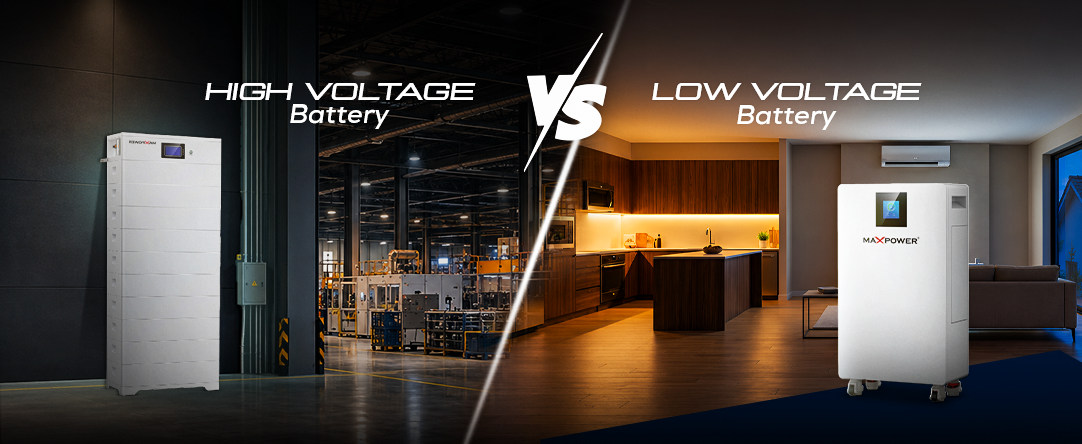
Choosing the Right Lithium Battery Architecture for Your Solar System
As solar energy adoption grows across homes, businesses, and industrial facilities, the question of how to store that energy becomes just as important as how to generate it. The lithium battery has become the undisputed standard for modern solar battery storage, replacing older lead‑acid technology with longer life, deeper discharge capability, and near‑zero maintenance. However, not all lithium batteries are built the same. One of the most important technical decisions you will face when designing a solar energy storage system is whether to use a low voltage or high voltage architecture.
This choice affects everything from system efficiency and installation complexity to safety, scalability, and long‑term cost. Whether you are powering a villa in Dubai, a factory in Lahore, or an off‑grid farm in Oman, understanding the difference between high voltage lithium batteries and low voltage lithium batteries is essential to maximizing your return on investment. This guide explains how each system works, where each excels, and how to determine which option is truly better for your specific application.
Low voltage lithium batteries typically operate at forty‑eight volts or lower, with the forty‑eight volt standard being the most common configuration for residential and small commercial solar systems. These batteries are often modular, rack‑mounted, or wall‑mounted units that connect in parallel to increase total storage capacity while keeping the system voltage stable. A typical 48V lithium battery setup might consist of multiple five‑kilowatt‑hour or ten‑kilowatt‑hour modules linked together to create a twenty to forty kilowatt‑hour bank.
Because of their lower voltage, these systems generally produce higher current for the same power output. They are widely used in residential hybrid solar systems, off‑grid cabins, and small businesses where the total power demand is moderate and the cable runs between the battery bank and inverter are relatively short. Many popular hybrid solar inverters on the market today are designed specifically to interface with 48V lithium battery systems, making them a convenient and proven choice for standard installations.
High voltage lithium batteries operate at significantly higher voltages, often ranging from one hundred and fifty volts to over four hundred volts depending on the manufacturer and system design. Rather than connecting low‑voltage modules in parallel, high voltage systems connect battery modules in series to multiply the voltage while maintaining lower current levels. A high voltage lithium battery bank for residential or commercial use might operate at two hundred, four hundred, or even eight hundred volts, interfacing directly with a compatible high‑voltage hybrid solar inverter.
These systems are increasingly common in large residential installations, luxury villas with high energy demand, commercial buildings, and industrial facilities where efficiency, rapid charging, and scalability are critical. Because they operate at higher voltage and lower current, they experience significantly lower resistive losses in cabling, which translates to higher overall round‑trip efficiency and reduced heat generation throughout the system.
One of the most important differences between high voltage and low voltage lithium batteries is electrical efficiency. In any electrical system, power loss increases with the square of the current multiplied by the resistance of the cable. This means that when a system operates at lower voltage, it must draw higher current to deliver the same amount of power, which dramatically increases heat loss in wires, connectors, and internal components.
Another major advantage of high voltage lithium batteries is their ability to charge and discharge more rapidly without excessive current stress. Because power equals voltage multiplied by current, a high voltage system can absorb or deliver large amounts of power while keeping current levels within safe, efficient ranges. This is particularly valuable when paired with large solar panel arrays that can generate substantial midday surplus, or in commercial applications where peak shaving requires rapid discharge during expensive evening tariff windows.
Low voltage systems can certainly charge and discharge quickly, but doing so requires very high current, which generates heat, accelerates wear on connectors, and can trigger thermal throttling by the battery management system. For homeowners who want to capture every available ray of sunshine, or businesses that need instantaneous backup transfer during grid instability, the superior charge and discharge dynamics of a high voltage lithium battery architecture often justify the additional complexity.
When planning a solar battery storage installation, it is important to consider not just your current needs but your future requirements. Low voltage lithium batteries are generally easier to expand in small increments. Because they operate in parallel, adding another 48V lithium battery module simply increases your total amp‑hour capacity without changing the system voltage, provided your inverter and charge controller can handle the additional capacity.
High voltage systems, by contrast, are typically designed with specific voltage targets in mind. Expanding them often requires adding modules in specific series configurations to maintain the target voltage, which means you need to plan your total desired capacity more carefully from the outset. However, high voltage systems often support much larger total capacities and can scale into the hundreds of kilowatt‑hours or megawatt‑hours for commercial and industrial applications in ways that low voltage residential banks simply cannot match without becoming unwieldy and inefficient.
For a typical family home looking to add ten or twenty kilowatt‑hours of storage, a low voltage system offers simple scalability. For a large villa, commercial complex, or factory anticipating future growth into hundreds of kilowatt‑hours, a high voltage architecture provides a cleaner, more efficient growth path.
Both high voltage and low voltage lithium batteries are safe when designed, installed, and managed correctly, but they present different engineering considerations. Low voltage systems generally pose lower absolute electrical shock risk during installation and maintenance because the potential difference between conductors is smaller. This can make them slightly more forgiving for installers and technicians working in confined residential spaces.
However, because low voltage systems require higher current, they generate more heat in cables and busbars, which can create hot spots if connections are loose or undersized. High voltage systems operate at lower current, reducing resistive heating in wiring, but they demand stricter safety protocols, insulated tools, and proper shutdown procedures during service because of the elevated voltage levels.
Modern high voltage lithium batteries incorporate sophisticated battery management systems with cell‑level monitoring, active balancing, and redundant safety disconnects that make them extremely safe despite the higher voltages. Similarly, quality 48V lithium battery systems include robust management electronics and thermal sensors. In both cases, choosing a reputable manufacturer with certified safety standards is more important than the voltage class itself.
Not every hybrid solar inverter can work with both voltage classes, so your choice of battery architecture will directly influence your inverter selection. The residential solar inverter market has historically been dominated by 48V lithium battery compatibility, meaning homeowners have a wide selection of proven, cost‑effective inverters to choose from. This is one reason why low voltage systems remain so popular for standard home installations.
High voltage hybrid solar inverters are increasingly available and are now standard in the large residential, commercial, and utility‑scale segments. These inverters are engineered to handle the elevated input voltages from high voltage lithium battery racks while delivering three‑phase power, advanced grid support functions, and rapid switching between grid, battery, and solar sources. If you are designing a large villa, a commercial warehouse, or an industrial plant, the availability of powerful high‑voltage inverters makes the battery decision easier.
It is essential to verify that your chosen solar inverter and battery communicate using compatible protocols. Many leading systems use proprietary or standardized communication interfaces that allow the inverter to read battery state of charge, temperature, and health data in real time, optimizing charging curves and preventing unsafe operating conditions. You can explore compatible options in the Maxell Power hybrid solar inverter collection and our range of lithium battery storage engineered for both voltage platforms.
Low voltage lithium battery systems are generally simpler to install. They use thicker cables but at safer voltage levels, and many units are designed for wall mounting or floor standing in standard residential utility rooms. Because the technology is so widely adopted, most experienced installers are thoroughly familiar with 48V lithium battery configurations, reducing labor time and commissioning complexity.
High voltage systems require more careful planning. The series connections must be assembled correctly to achieve the target voltage, and cabling must be properly insulated and routed to handle elevated potentials. However, because high voltage systems use thinner, more manageable cables for the same power level, installation can actually be cleaner and less physically demanding in large systems where low voltage would demand enormous, difficult‑to‑route conductors. Additionally, high voltage battery racks often occupy less physical space per kilowatt‑hour than equivalent low voltage banks, which is a significant advantage in commercial electrical rooms where floor space is expensive.
From a pure upfront cost perspective, low voltage lithium batteries generally have a lower entry price. The cells, management systems, and housings are produced in massive volumes for the residential market, and the competition among manufacturers keeps prices accessible. For a standard home installation, a 48V lithium battery bank often represents the most cost‑effective path to reliable solar energy storage.
High voltage lithium batteries typically command a higher initial price due to more complex management electronics, specialized packaging, and lower production volumes relative to the residential forty‑eight volt segment. However, when you factor in the higher round‑trip efficiency, lower cooling requirements, reduced cable costs at scale, and superior performance in large systems, the lifetime cost per kilowatt‑hour often favors high voltage architecture for commercial and large residential projects.
For a small villa with modest storage needs, the efficiency gains of high voltage may not be large enough to justify the price premium. For a large estate, a factory, or a facility with long cable runs, the operational savings quickly recover the additional capital expense.
For the majority of standard three‑ to five‑bedroom homes with typical air‑conditioning loads, a low voltage 48V lithium battery system paired with a quality hybrid solar inverter is the better practical choice. It offers an excellent balance of affordability, installer familiarity, safety, and scalability for capacities up to roughly forty kilowatt‑hours. Homeowners benefit from broad product availability, straightforward maintenance, and easy future expansion by adding parallel modules.
However, for luxury villas with multiple floors, large swimming pools, extensive smart home systems, and high baseline consumption exceeding sixty to eighty kilowatt‑hours of daily usage, a high voltage lithium battery system becomes increasingly attractive. The improved efficiency, faster charging from large solar panel arrays, and cleaner installation justify the transition once residential consumption approaches commercial levels.
In commercial, agricultural, and industrial environments, high voltage lithium batteries are generally the better choice. Facilities such as factories, cold storage warehouses, data centers, and shopping complexes require large amounts of stored energy, rapid charge and discharge cycles, and minimal energy loss across long cable distances. High voltage architecture delivers on all three requirements while integrating more cleanly with three‑phase hybrid solar inverters and building management systems.
Commercial users also benefit from the superior peak‑shaving capability of high voltage systems. By discharging stored energy rapidly during expensive demand charge periods, businesses can significantly reduce their monthly electricity bills in ways that lower‑current low voltage systems may struggle to match at scale. When a facility plans to store one hundred kilowatt‑hours or more, the physical and electrical inefficiencies of low voltage banks become prohibitive, making high voltage the clear winner.
For off‑grid cabins, remote telecommunications towers, and rural farmhouses, the choice depends heavily on system size and distance between components. Small off‑grid setups powering lights, refrigeration, and basic electronics are perfectly served by low voltage lithium batteries because the power demands are modest and the cabling distances are short.
For larger off‑grid installations, such as remote resorts, mining camps, or agricultural processing facilities, where the solar panel array may be located far from the battery room, high voltage lithium batteries dramatically reduce cabling losses and improve overall system stability. When every watt‑hour counts because there is no grid to fall back on, the efficiency advantage of high voltage becomes a critical survival factor.
Maxell Power provides advanced lithium battery solutions designed to integrate seamlessly with both low voltage and high voltage hybrid solar inverters. Our low voltage systems offer homeowners a reliable, scalable, and cost‑effective entry point into solar energy storage, with intelligent battery management, high depth of discharge, and proven compatibility with leading residential inverter brands.
For large villas, commercial buildings, and industrial facilities, our high voltage lithium battery racks deliver exceptional efficiency, rapid charge and discharge capability, and robust thermal management engineered for extreme climates. Whether you need a compact ten kilowatt‑hour residential bank or a multi‑hundred kilowatt‑hour commercial installation, Maxell Power ensures that your battery architecture matches your consumption, your inverter, and your long‑term expansion plans.
To find the ideal storage configuration for your property, explore our complete range of lithium battery storage systems and solar inverters designed for demanding Middle Eastern, Pakistani, and African environments.
There is no universal answer to whether high voltage or low voltage lithium batteries are better. The right choice depends entirely on your system size, electrical demand, installation environment, and budget. For standard residential homes, low voltage 48V lithium batteries offer an unbeatable combination of simplicity, affordability, and proven reliability. For large villas, commercial complexes, and industrial sites, high voltage lithium batteries provide superior efficiency, scalability, and performance that justify their higher initial investment.
By understanding these differences and selecting components that are fully compatible with your hybrid solar inverter and solar panel array, you can build a solar battery storage system that delivers decades of reliable service and maximum financial return.
Contact Maxell Power today for a free consultation and let our engineers recommend the optimal battery voltage architecture for your specific solar energy project.
Frequently Asked Questions
What is the main difference between high voltage and low voltage lithium batteries?
The primary difference is operating voltage. Low voltage lithium batteries typically run at forty‑eight volts or below and use higher current to deliver power, while high voltage lithium batteries operate at one hundred fifty to four hundred plus volts using lower current. High voltage systems generally offer better efficiency, lower cable losses, and faster charging, while low voltage systems are simpler, safer to handle, and more cost‑effective for small to medium residential setups.
Is a 48V lithium battery better than a high voltage battery for home solar systems?
For most standard homes, a 48V lithium battery is the better choice because it is more affordable, widely compatible with residential hybrid solar inverters, and easier to install and expand. However, for large luxury villas with very high consumption or long cable distances, a high voltage lithium battery may deliver superior efficiency and performance that justifies the additional complexity.
Can I use a high voltage lithium battery with any hybrid solar inverter?
No, you cannot use a high voltage lithium battery with any hybrid solar inverter. The inverter must be specifically designed and certified to accept the elevated input voltage and must communicate with the battery’s management system. Always verify voltage compatibility and communication protocol support before purchasing a battery and inverter combination.
Which lithium battery voltage is best for commercial solar storage?
For commercial, industrial, and large‑scale solar battery storage, high voltage lithium batteries are generally best. They minimize resistive losses over long cable runs, charge and discharge rapidly for effective peak shaving, and scale more cleanly into large capacities. They also integrate more efficiently with three‑phase commercial hybrid solar inverters and building energy management systems.
Are high voltage lithium batteries safe for residential installation?
Yes, high voltage lithium batteries are safe for residential use when installed by qualified professionals using proper safety protocols, insulated tools, and manufacturer‑approved procedures. Modern units include advanced battery management systems, redundant disconnects, and cell‑level monitoring. However, because of the elevated voltage, installation and servicing should always be performed by experienced technicians familiar with high‑voltage DC systems.
