
Maxell Power IP65 & IP66 Solar Inverters Heat & Weather Resistance Guide Against Monsoon Rains & Dust
August 16, 2026
Why IP66 Technology is Ideal for Kuwait
August 24, 2026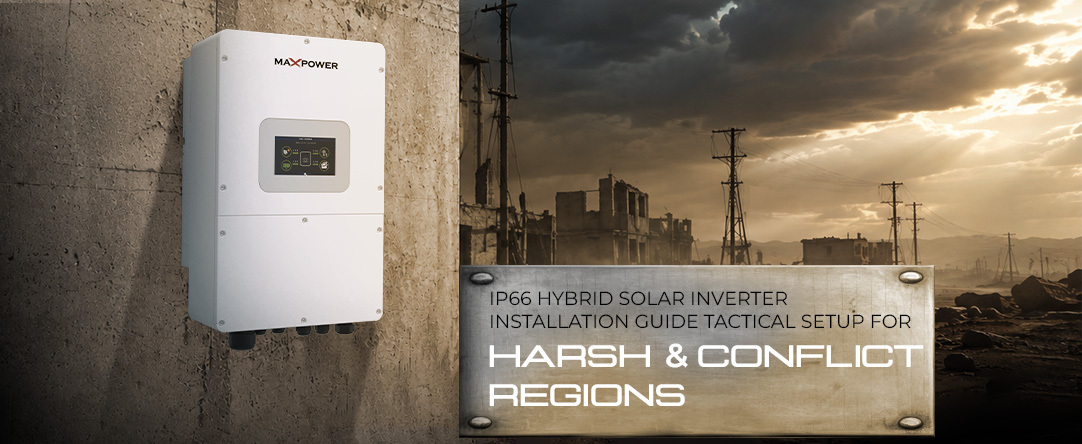
Installing solar in a conflict region or extreme environment is nothing like installing in a stable urban environment. The technical challenges go beyond simple shading and roof orientation. You face fine dust from damaged infrastructure, the risk of ballistic shrapnel, unreliable internet for monitoring, and the real possibility that you may need to evacuate with your core equipment.
In these hostile environments, an IP66-rated hybrid solar inverter has become the gold standard. Its completely dust-tight and high-pressure water-jet-resistant enclosure keeps internal electronics safe when standard IP20 units fail within weeks.
However, purchasing an IP66 inverter is only the first step. How you install it determines whether your energy system survives for years or fails during the next sandstorm. Below are field-tested technical tips for installing ruggedized solar power systems in harsh off-grid zones.
Standard Vs. Tactical IP66 Solar Installation
| Feature / Challenge | Standard Installation | Tactical / Harsh Zone Setup |
| Inverter Mounting | Exterior shaded wall | Reinforced interior corner or concrete enclosure |
| Cooling Strategy | Standard ambient airflow | Metal backplate heat sink extension on shaded walls |
| Component Protection | Standard IP20/IP44 isolators | IP66-rated junction boxes for all AC/DC isolators |
| Data Monitoring | Active Wi-Fi / Ethernet | Local Bluetooth 5.0 or RF loggers paired with field tablets |
| Battery Setup | Fixed rack-mounted lead-acid/lithium | Portable, modular Maxell Power Lithium Batteries with quick-disconnects |
Key Tactical Guidelines for IP66 Solar Systems
1. Physical Placement and Ballistic Considerations
In active conflict zones, your hybrid solar inverters and battery bank can easily become secondary casualties.
-
Do not mount the inverter on an exterior wall facing a street or open field.
-
Mount your inverter on an interior wall or in a corner where two thick exterior walls provide structural shielding.
-
Where possible, house the system inside a reinforced concrete enclosure with a lockable steel door. While an IP66 enclosure easily resists dust and torrential rain, it is not shrapnel-proof.
2. Passive Indirect Cooling Strategy
Heavy-duty sealed units, such as the Maxell 125K-HYD-H6 HV Three-Phase IP66 Inverter, do not utilize external air vents. Instead, heat dissipation relies entirely on an aluminum rear heatsink.
To maximize passive heat rejection during 45°C+ summer heat:
-
Mount the inverter onto a thick metal backplate to serve as an extended thermal heat sink.
-
Secure the entire assembly onto a north-facing, shaded masonry wall.
-
The thermal mass of the wall keeps operating temperatures lower than ambient air, extending capacitor lifespan significantly.
3. Protecting External DC & AC Isolators
While the IP66 inverter chassis remains completely sealed against fine silica dust, external DC disconnect switches and AC breakers are vulnerable point-of-failures.
-
House all external breakers inside IP66-rated junction boxes.
-
Utilize rotary isolators with double-break mechanisms to prevent arcing.
-
Coat external copper wiring terminals with anti-corrosion dielectric gel.
4. Waterless Solar Panel Maintenance
In remote regions, clean water is far too valuable to waste on panel washing. Adopt a dry-cleaning protocol:
-
Use a long-handled soft brush with microfiber strands.
-
Brush panels early at dawn when the glass surface is cool. Brushing hot panels mid-day causes thermal stress and expands microcracks in the PV glass.
5. Local Data Logging Without Internet
When cellular networks and satellite connections go offline, shift from cloud monitoring to local data storage:
-
Utilize Bluetooth 5.0 or Radio Frequency (RF) dongles.
-
Pair with a ruggedized site tablet to store up to 90 days of operational logs locally.
-
Download data during regular physical site inspections.
6. Modular Lithium Battery Setup for Rapid Evacuation
During emergencies, heavy lead-acid battery banks cannot be transported quickly.
-
Deploy modular Maxell Power LiFePO4 Lithium Batteries. A 2.5 kWh module weighs approximately 18 kg, making it easily transportable by a single technician.
-
Install industrial quick-disconnect plugs (e.g., Anderson connectors or MC4 inline fittings) on all power leads.
-
In an evacuation scenario, unplug the modular lithium packs, grab the primary IP66 inverter, and abandon the fixed solar mounting structure.
Frequently Asked Questions
Can I run a solar water pump in a conflict zone using a hybrid IP66 inverter?
Yes, but it is best to separate water pumping from critical building loads. Connecting a dedicated Maxell Power Solar Water Pump Inverter directly to a borehole prevents motor electrical shorts from shutting down your primary Maxpower Hybrid Solar Inverter.
How do I protect an IP66 inverter from EMP or lightning surges?
Install dual Surge Protection Devices (SPDs) and dedicated grounding. Place a Type 1 SPD on the incoming DC array wiring and a Type 2 SPD on the AC output. Ground the inverter chassis to an independent, dedicated copper earth rod rather than the building’s internal rebar to prevent stray voltage exposure.
What size lithium battery is practical for a portable evacuation system?
A 5 kWh capacity split into two 2.5 kWh modules is optimal. A single 2.5 kWh lithium module weighs around 18 kg and can run critical loads (communications, medical refrigeration) for 12 hours. Two modules can be rapidly disconnected and carried by one person during an emergency.
Should I bond neutral to ground in an off-grid IP66 inverter installation?
Yes, enable the internal neutral-ground bonding relay during off-grid operation. In unstable or disconnected grid environments, your hybrid solar inverter must automatically bond neutral to ground while in island/off-grid mode to prevent floating neutrals and electric shock hazards.
How often should the breather valve silica gel be replaced in an IP66 inverter?
Replace the silica gel cartridge every 6 months in humid climates and every 12 months in arid environments. The breather valve equalizes internal pressure while keeping out moisture. Replacing the desiccant prevents internal condensation from damaging sensitive power electronics.
Why Off-Grid Solar Outperforms Fuel Generators in Hostile Environments
Relying on fuel generators creates a critical vulnerability in hostile or isolated regions. Diesel generators create loud acoustic signatures, require continuous fuel supply lines, and fail when blockades occur.
Conversely, a silent IP66 hybrid solar inverter paired with Maxell Power Lithium Storage provides complete operational autonomy. It powers critical field infrastructure, charges medical devices, and maintains communications without revealing your location or relying on fuel supply chains.
Need a ruggedized, military-grade solar solution for a challenging location? Explore Maxell Power Inverters to secure long-term energy independence today.
