
Why 1–6 kW Solar Systems Are the Most Popular Choice for African Homes
July 27, 2026
Benefits of Small kW Solar Systems in Nigeria, Kenya, Sudan, and Morocco
August 9, 2026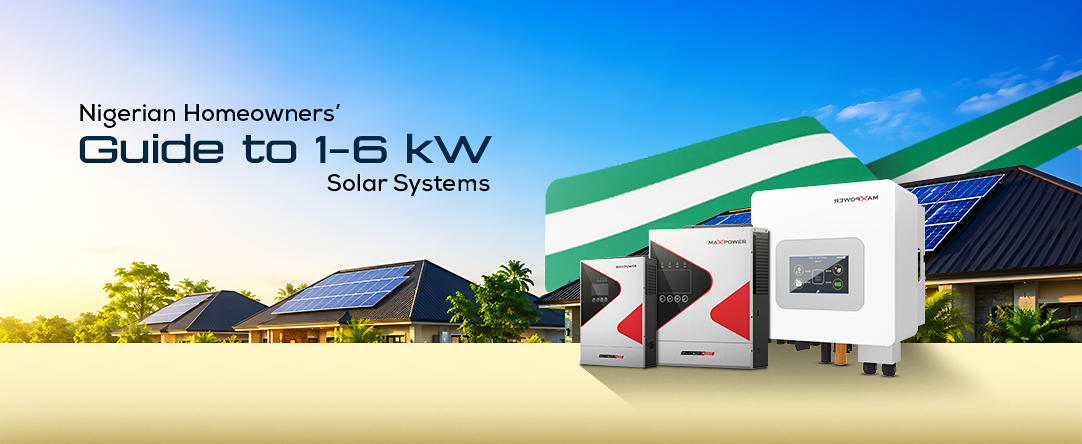
Living in Lagos, Abuja, or Port Harcourt means you understand the phrase “NEPA has taken light.” But the solution no longer requires covering your entire roof with heavy glass panels. The 1–6 kW solar systems Nigeria market has matured rapidly in the last 18 months. What changed? Battery prices dropped by nearly 40% between late 2024 and early 2026. More importantly, the average Nigerian home finally realized that a noisy 5 kVA generator running for 10 hours a day is a financial bleeding wound, not a backup plan.
The most common mistake I see in Nigerian Facebook solar groups is homeowners buying a 10 kW system for a 3-bedroom flat. You are paying for capacity you will never touch. Let me walk you through the actual consumption of a typical Nigerian family of five. Two standing fans, one 55-inch television, a decoder, six LED bulbs, a deep freezer, a laptop, a phone charger, and a water pressure pump. That entire list draws 1,800 watts at peak. A 3 kW hybrid solar inverter handles that with 40% headroom to spare.
Why 6 kW Is the Realistic Maximum for Most Nigerian Plots
Consider your roof space. A standard semidetached duplex in Lagos has approximately 45 square meters of usable south-facing roof after you account for water tanks and TV antennas. That space fits exactly 18 pieces of solar panels from the Maxpower series. Those 18 panels produce roughly 5.4 kW under our hazy harmattan conditions. So a 6 kW solar system is literally the physical limit for most urban Nigerian homes before you start building ground mounts in your already small compound.
The financial argument is even sharper. A 2025 survey by the Renewable Energy Association of Nigeria found that 72% of homeowners who installed systems above 6 kW regretted the extra cost within two years. Why? Because the payback period jumps from 2 years to over 4 years. You are better off putting that extra money into a larger lithium battery bank than into more panels you will never fully utilize.
The Naira and Kobo Reality of Sizing
Let me give you a real calculation. A 1–6 kW solar system Nigeria package from a reputable supplier includes the hybrid solar inverters, the lithium battery, and the solar panels. For a 3.5 kW system with a 5 kWh lithium battery, expect to pay between 2.5 million and 3.2 million Naira as of early 2026. That same home spends roughly 120,000 Naira monthly on diesel for a generator. The solar system pays for itself in 22 months. After that, you are effectively earning 1.4 million Naira per year in avoided fuel costs.
Now compare that to an 8 kW system. The cost jumps to nearly 7 million Naira. Your fuel savings do not double because your fuel consumption was already capped by what you actually use. You end up with a 40% longer payback period and a system that sits idle most of the day.
Sizing Your Battery Correctly
Nigerian homeowners obsess over panel wattage but neglect the batteries. A 1–6 kW solar system Nigeria setup needs a lithium battery that can carry you through the night until 8 AM when the sun returns. For most families, 5 kWh of usable storage is sufficient. That runs your fans, TV, lights, and a small fridge for 10 hours. If you run a deep freezer, go to 8 kWh. But never buy a battery larger than your inverter can charge. A 3 kW hybrid solar inverter typically maxes out at a 60-amp charge current. That pairs perfectly with a 5 kWh lithium battery.
Frequently Asked Questions
Can a 1–6 kW system power my welding machine or industrial equipment?
No, and you should not try. Welding machines have inrush currents that can exceed 10 kW briefly. For a small home workshop running a grinding machine or a drilling machine under 2 HP, a 6 kW solar system works fine. But welding requires a dedicated heavy-duty inverter or a generator. Maxell Power offers specific water pumping solutions for boreholes, but industrial welding is outside the residential scope.
How often do I need to replace my lithium battery in Nigerian weather?
Heat is your enemy. If you install your lithium battery in a well ventilated area away from direct sun and your inverter’s heat exhaust, expect 8 years of useful life. Install it inside a metal box on a south facing balcony in Lagos, you might get 4 years. Maxell Power’s lithium battery enclosures include passive cooling fins designed for tropical climates.
What happens during a week of heavy rainfall and no sun?
Your hybrid solar inverters will automatically switch to grid charging or generator charging. This is why you never go fully off grid in Nigeria unless you have a massive battery bank. The smart approach is a grid tied hybrid system. You charge from the sun when available. When rain persists for more than 48 hours, allow the inverter to pull a small top up from the grid. Your electricity bill for that week will be under 3,000 Naira.
Is NEPA power useful for anything in a solar home?
Yes, surprisingly. Modern hybrid solar inverters can blend NEPA power with solar power. If NEPA is delivering 180 volts instead of 220, the inverter supplements the missing 40 volts from your lithium battery. Your lights never flicker. Your appliances never see the brownout. You stop being a victim of the grid’s poor quality.
Can I expand my 3 kW system to 6 kW later?
Only if you buy the right inverter today. A 3 kW hybrid solar inverter can never become a 6 kW inverter. But you can buy a 6 kW inverter and initially install only 2 kW of solar panels. Then add panels and batteries over 2 years as your budget allows. This is the most financially intelligent way to enter solar in Nigeria. The inverter is the brain. Never undersize the brain.
Is Your Roof Actually Pointing the Wrong Direction?
Most Nigerian homes have roofs facing east and west, not north or south. This is a colonial architectural leftover. An east-facing array produces 30% less total energy annually than a south-facing array. But here is the trick: an east-facing array produces more energy in the morning when you need to charge your lithium battery after the night’s drain. So do not blindly reorient your house. Model your specific azimuth. A 1–6 kW solar system Nigeria expert from Maxell Power can run a PVsyst simulation for your exact address to tell you the optimal tilt and orientation.
Ready to size your perfect solar system for your Nigerian home? Stop guessing. Contact Maxell Power for a free load audit and a customized quote using only Nigerian weather data. Visit our inverter collection or reach us directly.
