
Nigerian Homeowners’ Guide to 1–6 kW Solar Systems
August 2, 2026
Maxell Power IP65 & IP66 Solar Inverters Heat & Weather Resistance Guide Against Monsoon Rains & Dust
August 16, 2026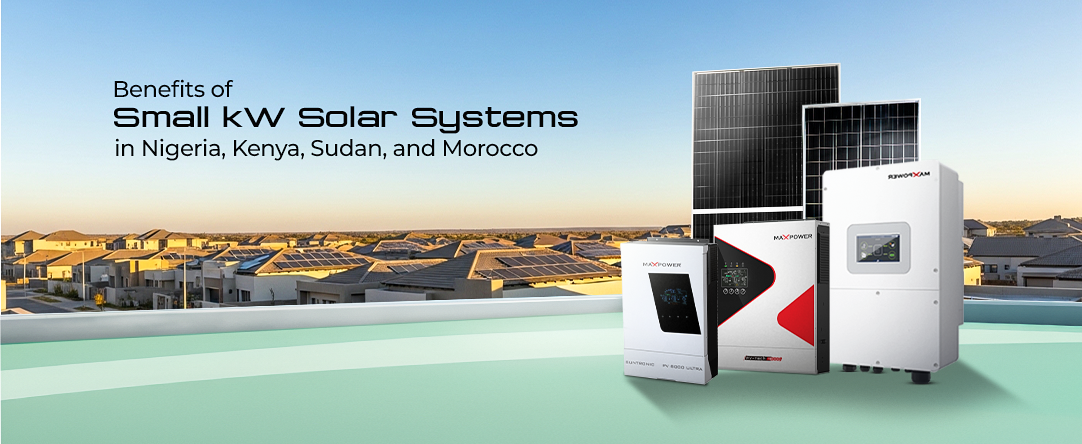
The one-size-fits-all approach to solar does not work across a continent as diverse as Africa. A home in humid Lagos faces different challenges than a home in arid Khartoum or in chilly Casablanca. Yet remarkably, the low kW solar systems category of 1 to 6 kW delivers benefits across all four nations. The common thread is not the weather. It is the grid behavior and the economic reality of the middle class.
Let me be specific. In 2025, the World Bank’s Energy Sector Management Assistance Program published data showing that homes with low-kW solar systems in these four countries experienced an average uptime of 98%, compared to 62% for grid-dependent neighbors. That is not a minor improvement. That is the difference between your frozen food spoiling weekly versus your children studying under LED lights every night.
Nigeria: The Fuel Subsidy Hangover Benefit
Nigeria removed fuel subsidies in 2023. By 2026, diesel prices have stabilized at a painful 1,200 naira per liter. A 5 kVA generator consumes 1 liter per hour under load. Run it 8 hours daily, and you spend 288,000 Naira monthly. A low kW solar system setup with a 5 kW hybrid solar inverter and 8 kWh lithium battery costs roughly 4 million Naira. Your payback period is 14 months. After that, you are saving nearly 3.5 million Naira annually. The secondary benefit is noise reduction. Your neighbors will stop hating you because you eliminated the midnight generator rumble.
Kenya: The Tariff Time Bomb
Kenya has some of East Africa’s most progressive renewable energy policies, but the tariff structure punishes peak usage. Between 5 PM and 9 PM, Kenya Power charges nearly triple the off-peak rate. A low kW solar system setup with a hybrid solar inverter allows you to store solutions during the day for storage and run your evening loads from your lithium battery. You never draw from the grid during those expensive peak hours. Families in Nairobi report reducing their monthly electricity bills from 15,000 Kenyan Shillings to just 2,500 Shillings, a monthly savings of 12,500 Shillings.
Sudan: The Conflict Resilience Benefit
This is a sensitive but critical point. In regions experiencing active conflict, the national grid becomes a target or simply stops functioning. A low kW solar system installation with an IP66 inverter offers energy security that diesel cannot match. Why? Because diesel supply lines are easily cut. Fuel becomes scarce or astronomically expensive during conflict. Solar panels on your roof produce power silently without resupply. The IP66 inverter survives the fine Saharan dust that destroys standard electronics within months. Families in Port Sudan and even Khartoum’s outskirts have maintained refrigeration and communications for over two years purely on low kW solar systems while the grid remained dead.
Technical Tip for Sudan and Similar Climates
You must install solar panels at a steeper tilt than usual. The standard 15-degree tilt collects dust rapidly. Increase to 25 or 30 degrees. Rain will wash the panels naturally during the brief wet season. In dry months, a weekly wipe with a dry microfiber cloth restores 95% output. Pair this with a Maxell Power IP66 inverter mounted on a shaded north-facing wall. Your system will outlast the instability.
Morocco: The Winter Night Challenge
Morocco presents a different problem. Winter nights are long and cold. You use space heaters and electric blankets. A low kW solar system setup must account for the December sun angle, which is low on the horizon. A 4 kW array in Marrakech produces only 2.2 kWh on a cloudy December day. This is where hybrid solar inverters with grid assist shine. You do not need a larger array. You need a lithium battery large enough to store 3 days of winter energy. The benefit for Moroccan homeowners is avoiding the state utility’s winter peak tariffs, which can spike to 2.5 Moroccan dirhams per kWh. A properly sized low kW solar system installation reduces winter electricity bills by 70%.
The Night Storage Hack
Moroccan homes benefit from an unusual strategy. Oversize your lithium battery relative to your solar panels. A 3 kW array paired with a 10 kWh lithium battery allows you to charge fully during the limited winter daylight and discharge slowly through the 14-hour winter night. This configuration is inefficient in Nigeria where nights are shorter, but it is optimal for Morocco’s latitude.
Frequently Asked Questions
Can a low kW system power a water pump for my farm in Kenya?
Yes, but you need separate water pumping solutions hardware. A residential hybrid solar inverter is not designed for the startup surge of a submersible pump. Maxell Power’s dedicated water pumping solutions category includes variable frequency drives that soft start pumps up to 3 HP. For a 1 HP pump watering a small vegetable garden, a 3 kW hybrid solar inverter works fine.
Which country has the fastest payback for low kW solar?
As of 2026, Nigeria has the fastest payback at 14 to 18 months due to high diesel costs. Sudan follows at 20 months but with higher risk. Kenya averages 24 months. Morocco averages 30 months due to lower grid tariffs but offers the longest equipment lifespan because of the milder climate.
Do I need different solar panels for Sudan’s heat versus Morocco’s cold?
No. Standard monocrystalline solar panels like the Maxpower series operate efficiently from -20°C to +60°C. What changes is the mounting. In Sudan, you need an air gap behind the panels for cooling. In Morocco, you mount flush to reduce wind lift during Atlantic storms.
Is a lithium battery safe in Sudan’s 50°C heat?
Lithium batteries degrade rapidly above 45°C. You have two options. Install the battery inside your living space where you have air conditioning or evaporative cooling. Or use a lithium battery with an integrated liquid cooling loop. Maxell Power’s high temperature lithium battery series includes a passive phase change material that absorbs heat during the day and releases it at night.
Can I take my low kW system with me if I move homes?
Yes, and this is an underappreciated benefit. A low kW solar systems setup is modular. You disconnect the solar panels from the roof, pack the hybrid solar inverters and lithium battery into a vehicle, and reinstall at your new address. The moving cost is roughly 5% of the original installation price. You cannot do that with a grid connection.
Are You Overlooking the Easiest 20% Energy Saving?
Before you spend money on more panels, look at your appliances. A refrigerator from 2010 consumes 3 times more electricity than a 2025 model. Replace it first. Then install your low kW solar systems. The combination of efficient appliances and a 4 kW solar array often outperforms a 6 kW array powering old, inefficient appliances. That is the secret that solar salesmen do not tell you.
Ready to see exactly how much you will save in your specific country? Maxell Power has country specific ROI calculators for Nigeria, Kenya, Sudan, and Morocco. Contact our team or explore our battery options.
