

Top Solar Companies in the Middle East and Africa: Who Is Leading the Market in 2026?
July 10, 2026
How to Choose the Right Solar System Size for Your Home in the Middle East and Africa
July 15, 2026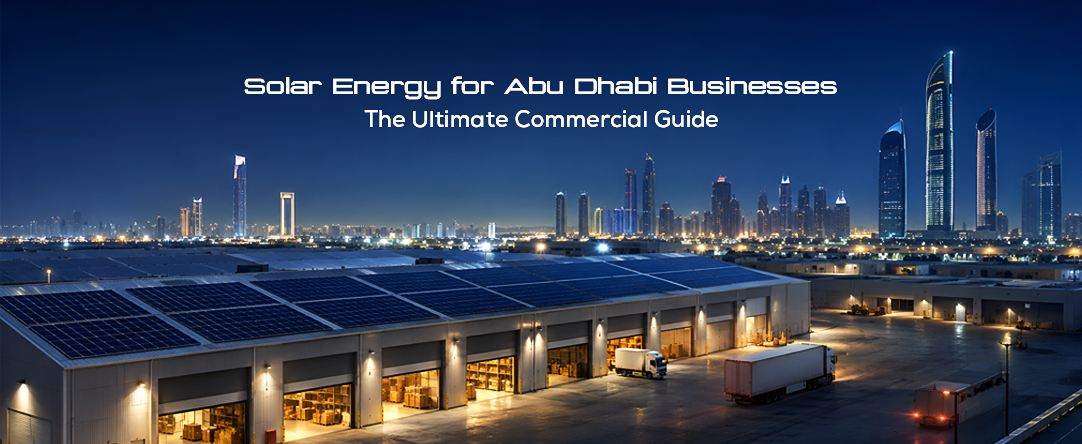
With rapid industrial expansion across Abu Dhabi, commercial property managers, logistics operators in Mussafah, and corporate hubs in Al Maryah Island face significant utility overheads—driven mainly by heavy HVAC cooling demands and operational machinery.
Under the UAE Energy Strategy 2050 and local initiatives governed by the Abu Dhabi Department of Energy (DoE) and Abu Dhabi Distribution Company (ADDC), solar energy is no longer just a sustainability goal—it is a core strategic move to protect long-term profit margins.
This guide explores how businesses across the Emirate can deploy commercial rooftop and carport photovoltaic (PV) systems, optimize energy usage through high-capacity lithium storage, and achieve a fast Return on Investment (ROI).
Why Abu Dhabi Businesses Are Transitioning to Commercial Solar
Integrating commercial solar systems offers immediate financial resilience and operational stability for facilities in Abu Dhabi, Al Ain, and the Al Dhafra region:
- Slashing Operational Expenses (OpEx): Commercial electricity tariffs spike during daytime peak operational hours. Solar energy directly offsets daytime load demand, lowering monthly utility expenses by 60% to 80%.
- Predictable 4.5 to 6.5 Year Payback: High year-round solar irradiance in the GCC enables well-engineered commercial solar arrays to recover initial capital investment within 4.5 to 6.5 years, unlocking 20+ years of low-cost power afterwards.
- ESG & Corporate Sustainability Compliance: Meeting regional green mandates and tender qualification requirements (such as ISO 14001 or Net-Zero commitments) enhances market positioning for international and government contracts.
- Energy Independence via Battery Storage: Pairing solar arrays with industrial LiFePO4 energy storage safeguards critical manufacturing lines, cold storage, and data servers against grid fluctuations.
Estimated Commercial Solar Costs & Capacity Guidelines
Commercial solar setups vary based on usable roof area, structural layout, three-phase power requirements, and daily consumption profiles.
| Facility Type & Sector | Typical System Size (kWp) | Estimated Investment Range (AED) | Average Payback Period |
| Retail Outlets & Commercial Showrooms | 15 kWp – 50 kWp | AED 55,000 – AED 150,000 | 5.5 – 6.5 Years |
| Mid-Size Office Buildings & Schools | 50 kWp – 150 kWp | AED 160,000 – AED 450,000 | 5.0 – 6.0 Years |
| Mussafah / ICAD Logistics & Warehouses | 150 kWp – 500 kWp+ | AED 450,000 – AED 1,300,000+ | 4.5 – 5.5 Years |
| Large Industrial Plants & Factories | 1 MWp+ | Custom Turnkey Engineering | Under 4.5 Years |
(Note: Turnkey pricing includes Tier-1 solar modules, commercial inverters, industrial mounting frames, wiring, and ADDC compliance management).
Abu Dhabi Regulatory Framework: ADDC & Energy Management
Connecting a commercial PV system to the local power infrastructure requires compliance with the Abu Dhabi Department of Energy (DoE) standards managed through ADDC (or AADC in Al Ain).
- Daytime Load Matching: System sizing focuses on powering the facility’s real-time daytime base load (air conditioning, heavy machinery, processing units).
- Smart Grid Connection: Installers manage the No Objection Certificate (NOC) and technical design submittals through ADDC-approved integrators before final meter connection.
- Behind-the-Meter Optimization: Maximizing on-site consumption ensures maximum financial efficiency from every kilowatt-hour generated during peak sun hours.
Commercial Battery Storage: Maximizing On-Site Solar Utilization
Because commercial energy demands often extend past sunset or vary across shifts, relying solely on daytime solar output can leave uncaptured energy potential. Integrating an Industrial Battery Energy Storage System (BESS) captures daytime solar energy for use during peak evening tariff hours or overnight shifts.
To handle high ambient heat conditions in the Gulf region, Maxell Power engineers heavy-duty LiFePO4 (Lithium Iron Phosphate) storage units designed for Middle Eastern commercial operations:
- High Heat Resilience: Built-in smart thermal dissipation operates reliably in ambient temperatures up to 50°C.
- Modular High-Voltage Scalability: Commercial models like the MP-10000 Ultra, MP-16000 Ultra, and MP-32000 Ultra connect in parallel to deliver high storage capacities for industrial facilities.
- Peak Shaving Capabilities: The intelligent BMS balances charge and discharge schedules to optimize electricity costs during peak grid periods.
Explore detailed specs in the official Maxell Power Lithium Storage Catalogue.
Steps to Deploy Commercial Solar in Abu Dhabi
- Feasibility Audit: Certified engineers review historical utility bills, perform structural roof assessments, and calculate shade impacts.
- ADDC NOC Submission: The approved contractor submits electrical single-line diagrams (SLD) and structural designs to ADDC for official NOC issuance.
- Procurement & Installation: Mounting frames, high-efficiency panels, three-phase inverters, and battery storage units are installed according to Abu Dhabi electricity wiring standards.
- Inspection & Commissioning: ADDC inspectors complete safety checks and authorize system activation.
To learn more about extending system hardware life under extreme local weather, read our technical insights on maximizing lithium battery life in the MEA region.
Frequently Asked Questions
What is the average ROI and payback period for commercial solar in Abu Dhabi?
The typical payback period for commercial solar installations in Abu Dhabi ranges from 4.5 to 6.5 years. Because Tier-1 solar modules carry 25-year performance warranties, businesses secure over 18 to 20 years of low-cost energy after recovering their initial investment.
Do businesses need ADDC approval before installing solar panels?
Yes. ADDC approval is mandatory. Commercial property owners must engage an ADDC-approved solar consultant or integrator to handle technical submittals, secure No Objection Certificates (NOCs), and ensure full grid compliance prior to energizing the system.
How do commercial solar panels handle extreme ambient heat in Mussafah and ICAD?
Tier-1 commercial panels and industrial storage systems feature low temperature-coefficients and heavy-duty IP65/IP66 enclosures. High-grade LiFePO4 batteries (such as Maxell Power Ultra series) include intelligent BMS thermal management to maintain efficiency in temperatures exceeding 45°C–50°C.
Is commercial battery energy storage (BESS) recommended for Abu Dhabi facilities?
Yes, especially for facilities with 24/7 operations, cold storage, or night shifts. Adding a battery storage system lets you capture excess daytime generation and deploy it after sunset, protecting sensitive machinery from unexpected power dips while reducing grid dependency.
How long does the entire commercial solar deployment process take?
From the initial site engineering audit and ADDC NOC approvals to procurement, installation, and final utility commissioning, the complete process generally takes 6 to 12 weeks, depending on system size and facility complexity.
Take Control of Your Commercial Energy Expenses
Investing in a commercial solar array turns ongoing operational utility costs into long-term financial equity, insulating your business against rising tariff rates for decades.
Evaluating solar feasibility or high-capacity energy storage for your Abu Dhabi facility?
Browse the full range of Maxell Power Commercial Lithium Batteries or reach out directly via our official Maxell Power Contact Page for technical consultations and project estimates.
