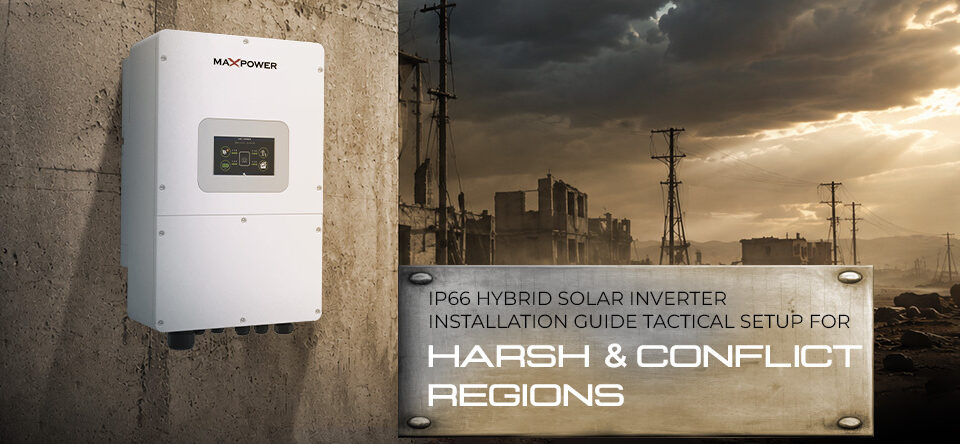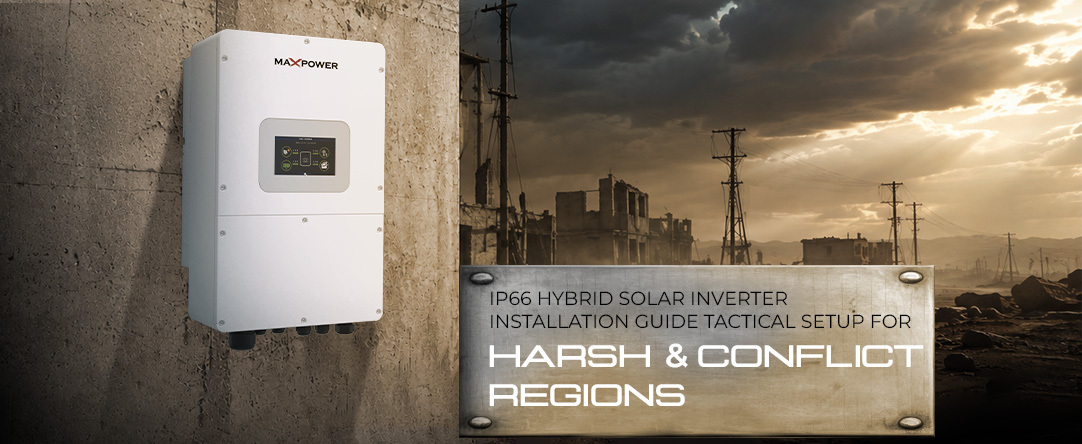
IP66 Hybrid Solar Inverter Installation Guide Tactical Setup for Harsh & Conflict Regions
August 18, 2026Energy costs represent one of the single largest operating expenses for manufacturing plants, textile mills, food processing units, and heavy industrial facilities across the Middle East and Africa (MEA) region. With rising grid tariffs, stringent corporate sustainability mandates, and the harsh operating environment of hot, high-ambient regions like the UAE (Dubai, Abu Dhabi, JAFZA), Saudi Arabia (Riyadh, Dammam), Oman, and Egypt, industrial leaders are rapidly transitioning to high-capacity solar PV installations.
In extreme weather zones where summer temperatures routinely exceed 45°C to 50°C and airborne sand or dust is constant, off-the-shelf residential solar equipment fails to deliver long-term reliability. Industrial applications demand heavy-duty, high-efficiency solar ecosystems—comprising robust solar modules, high-capacity 3-phase hybrid inverters, and high-voltage energy storage—engineered specifically to handle heat stress, voltage spikes, and non-stop operational loads.
The Industrial Energy Challenge in Hot & Extreme Climates
Manufacturing and industrial facilities face distinct power challenges compared to standard commercial buildings:
-
High Surge Currents & Heavy Motor Loads: Machinery, industrial compressors, automated conveyor belts, and HVAC systems draw substantial startup surges that can trip underrated power backup systems.
-
Thermal Derating & Overheating: Extreme ambient temperatures cause low-tier inverters to thermal-derate (automatically throttle down power generation) to prevent internal component damage, resulting in huge energy yield losses during peak sun hours.
-
Continuous 24/7 Production Downtime Risks: Halting production due to grid instability, voltage sags, or load-shedding results in significant financial losses per hour.
-
Environmental Degradation: Desert dust, salt haze near coastal manufacturing hubs, and ambient heat rapidly degrade standard solar electrical components unless they carry industrial-grade IP ratings.
Technical Pillars of a Heat-Resilient Industrial Solar Ecosystem
To maintain optimal yield and operational uptime in demanding Middle Eastern and South Asian manufacturing environments, an industrial solar infrastructure relies on three core equipment pillars:
[Industrial Grid / Utility Feed]
                 │
                 ▼
 ┌─────────────────────────────────────────┐
 │ High-Wattage Monocrystalline PV Arrays │
 │ (Half-Cut / Bifacial Heat-Resistant)   │
 └───────────────────┬─────────────────────┘
                     │
         ┌───────────┴───────────┐
         ▼                       ▼
┌──────────────────┐    ┌──────────────────┐
│ 3-Phase Industrial│    │ High-Voltage     │
│ Hybrid Inverter  │───►│ LiFePO4 Battery  │
│ (IP65 / IP66)    │    │ Storage System   │
└────────┬─────────┘    └──────────────────┘
         │
         ▼
┌──────────────────────────────────────────┐
│ Heavy Manufacturing Loads & SCADA Sync   │
│ (Compressors, Motors, Production Lines)  │
└──────────────────────────────────────────┘
High-Efficiency Industrial Solar Panels (Bifacial Half-Cut)
Industrial rooftops require modules that maximize power density per square foot. High-wattage Monocrystalline PERC and Bifacial half-cut photovoltaic modules deliver lower balance-of-system (BOS) costs, low temperature coefficients, and high light absorption even during hazy or dusty desert days. Explore the full range of high-efficiency solar panels at Maxell Power engineered to handle extreme Middle Eastern sunlight.
High-Voltage 3-Phase Solar Inverters (On-Grid & Hybrid)
The inverter is the core of any manufacturing solar plant:
-
High-Capacity 3-Phase Inverters: Units ranging from 12kW up to 125kW+ (including the 100K-HYD-H6 and 125K-HYD-H6 HV Three-Phase series) sync directly with 400V/415V 3-phase industrial power grids.
-
IP65/IP66 Protection Ratings: Inverters installed outdoors or near dust-heavy plant environments require sealed enclosures (IP65/IP66 rated) to lock out fine sand particles, moisture, and chemical vapor. Browse the complete selection of commercial-grade solar inverters to match your facility’s exact load requirements.
-
Smart SCADA & Net-Metering Integration: Industrial-grade inverters integrate with plant SCADA systems, support zero-export control where required, and enable net-metering integration with local utilities (such as DEWA in Dubai or SEC in Saudi Arabia). You can also view dedicated hybrid solar inverters for seamless integration with energy storage.
High-Voltage Energy Storage Systems (LiFePO4 Chemistry)
To bridge power gaps, smooth peak demand charges, or maintain critical assembly lines during power dips, high-voltage Lithium Iron Phosphate (LiFePO4) battery banks provide safety, long cycle life (6,000+ cycles), and rapid thermal dissipation. Discover reliable lithium battery storage solutions—such as the MP-16000 Ultra and MP-32000 Ultra series—built specifically for high-ambient temperatures.
Comparison: Inverter Enclosure Protection Ratings for Factories
Selecting the correct enclosure rating determines whether an inverter survives hot industrial setups:
| Technical Feature | IP21 Inverter | IP65 Inverter | IP66 Inverter |
| Primary Installation | Indoor climate-controlled control rooms | Outdoor rooftop / shaded factory wall mounts | Heavy-dust outdoor/harsh industrial zones |
| Ingress Dust Protection | Basic protection (>12.5mm objects) | Complete dust-tight sealed enclosure | Complete dust-tight sealed enclosure |
| Moisture Resistance | Drip-proof against vertical water droplets | Protected against low-pressure water jets | Protected against high-pressure water jets & heavy rain |
| Ideal Climate Application | Standard indoor electrical cabinets | Standard Middle East commercial installations | Heavy industrial plants, desert areas, coastal sites |
Key Advantages of Solar Power for Manufacturing Facilities
-
Substantial Operational Cost Reduction: On-site solar generation locks in predictable, low-cost electricity for 25+ years, insulating manufacturing operations against rising commercial electricity tariffs.
-
Peak Shaving & Demand Charge Management: Factories often pay heavy penalties for high peak power consumption. Integrated lithium battery storage offsets peak load spikes automatically.
-
Enhanced Power Quality & Line Stability: Hybrid industrial inverters buffer sensitive automated assembly lines from grid voltage sags, phase imbalances, and harmonic distortions.
-
ESG & Regional Vision Compliance: Aligning with regional decarbonization frameworks (such as UAE Net Zero 2050 and Saudi Vision 2030) improves supply chain eligibility for global corporate buyers.
Partnering with Maxell Power for Industrial Solar Deployment
For manufacturing plants and industrial facilities across Dubai, Abu Dhabi, Saudi Arabia, Oman, and the wider Middle East, choosing a dedicated solar partner like Maxell Power ensures equipment is engineered from the ground up for severe heat and high-demand applications. From robust 3-phase hybrid inverters and high-output solar modules to high-voltage lithium battery systems, Maxell Power provides complete, climate-ready energy solutions designed to lower levelized cost of energy (LCOE) and protect operational uptime.
Learn more about regional distribution, custom commercial quotes, and technical specs on the Maxell Power About Page or directly Contact Maxell Power to discuss your industrial project needs.
Frequently Asked Questions
How do industrial solar inverters handle extreme high-ambient temperatures in hot desert regions?
Industrial-grade solar inverters engineered for MEA climates feature active cooling systems, advanced heat sinks, and wide operating temperature thresholds (up to 60°C). Unlike residential inverters that throttle generation (thermal derating) when ambient heat rises above 40°C, commercial-grade IP65/IP66 models maintain high output without overheating.
What is the difference between single-phase and 3-phase hybrid solar inverters for manufacturing plants?
Single-phase inverters are designed for smaller residential loads (230V). Manufacturing plants and industrial warehouses run on 3-phase power grids (400V/415V) to power heavy machinery, compressors, and large HVAC units. A 3-phase hybrid solar inverter (like the VOLTAS or HYD 3-Phase series) distributes solar power evenly across all three electrical phases, preventing voltage imbalances and phase trips.
Can a factory operate completely off-grid using solar and lithium batteries?
Yes, factories can run on hybrid or off-grid solar setups paired with high-capacity LiFePO4 lithium batteries. However, most industrial setups use grid-tied or hybrid configurations to blend solar, battery storage, and utility grid power for maximum cost efficiency and uninterrupted power supply (UPS) functionality.
What IP rating is required for solar inverters installed in hot, dusty industrial zones?
An IP65 rating is the minimum requirement for outdoor commercial installations, as it prevents fine dust from entering the electronics and protects against low-pressure water. For extreme dust, high humidity, or coastal industrial zones (like JAFZA or Yanbu), an IP66-rated inverter offers superior protection against dust ingress and high-pressure environmental factors.
How does net-metering work for commercial and industrial solar installations in the Middle East?
Net-metering policies (such as DEWA’s Shams Dubai or SEC’s solar framework in KSA) allow industrial facilities to export excess solar energy generated during non-peak production hours (e.g., weekends) back to the public grid. These exports are credited against the facility’s utility bill, significantly accelerating the return on investment (ROI)