
IP66 Hybrid Solar Inverter Installation Guide Tactical Setup for Harsh & Conflict Regions
August 18, 2026
Best Solar Inverter for Riyadh’s High Temperatures
August 29, 2026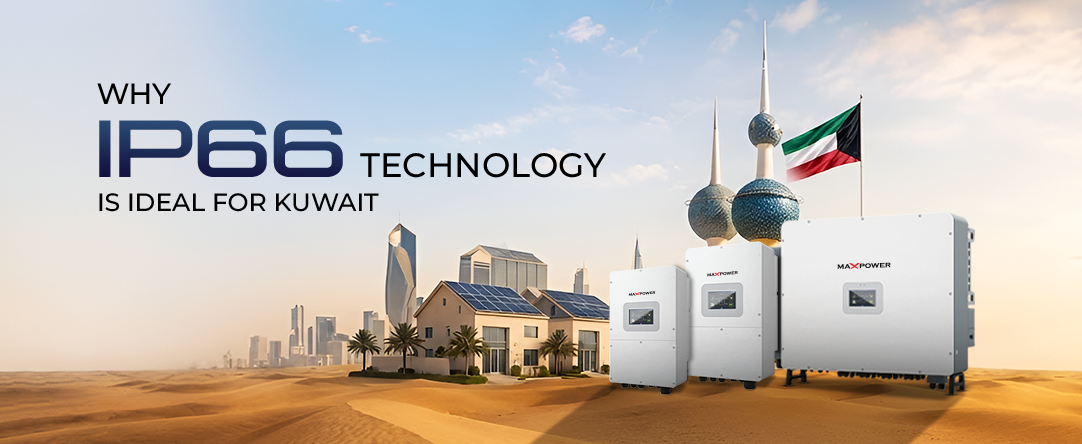
Kuwait presents one of the most punishing operating environments in the world for solar energy infrastructure. With summer ambient temperatures frequently exceeding 50°C, extreme ground-level heat radiation, and intense seasonal sandstorms (Shamal winds), solar installations across Shuwaikh Industrial Area, Shagaya Renewable Energy Park, and commercial facilities face constant operational stress.
While solar PV panels capture Kuwait’s abundant sunlight, the system’s longevity and daily energy yield depend heavily on the inverter. Standard indoor-rated or basic IP20/IP54 units quickly succumb to thermal throttling, fine silica dust penetration, and electrical short circuits when exposed to local conditions.
To ensure continuous power generation, maximum Return on Investment (ROI), and zero unscheduled downtime, commercial and industrial project managers in Kuwait are transitioning to high-capacity IP66 ingress-protected solar inverters.
This guide explores why IP66 technology from Maxell Power provides the ultimate defense for solar installations across Kuwait and the broader GCC.
The Kuwait Climate Challenge: Heat, Silica Dust, and Humidity
Operating solar power electronics in Kuwait requires protection against three distinct environmental threats:
-
Extreme Summer Temperatures: Kuwait regularly records peak shade temperatures above 50°C, causing unrefined inverters to enter heavy “thermal derating” (lowering power output to avoid overheating).
-
Fine Silica Sandstorms (Shamal): High-velocity desert winds carry airborne sand and microscopic dust particles that lodge inside electronic units, acting as an insulating layer that traps heat and leads to short circuits.
-
Coastal Atmospheric Humidity: Coastal areas near Kuwait City and Ahmadi experience severe summer humidity, which turns accumulated internal dust into conductive paste.
What Makes IP66 Ingress Protection Essential for Kuwait?
Ingress Protection (IP) ratings classify the degree of sealing effectiveness against physical solids and moisture.
The IP66 rating is broken down into two highest-tier protection levels:
-
First Digit (6) — Complete Dust Immunity: The highest possible dust rating. Enclosures are 100% sealed against fine silica dust, desert sand, and airborne soil particles.
-
Second Digit (6) — High-Pressure Water & Storm Protection: Enclosures resist high-pressure, heavy water jets from any direction. This protects power electronics during severe regional downpours and high-pressure maintenance washdowns.
Key Takeaway: While standard IP65 units protect against low-pressure splashing, IP66-rated inverters feature heavy-duty industrial seals that prevent fine desert dust and high-pressure washdown water from reaching internal circuit boards (PCBs).
Key Advantages of Maxell Power IP66 Inverters in Kuwait
Engineering solar projects with Maxell Power IP66 Commercial & Hybrid Inverters gives developers direct performance and financial advantages:
1. Eliminates the Need for Air-Conditioned Inverter Rooms
Standard indoor inverters require dedicated, climate-controlled containerized rooms to survive Kuwait’s summers, significantly increasing upfront Capital Expenditure (CapEx) and continuous auxiliary power costs. Maxell Power IP66 units can be mounted directly outdoors under shaded structures or warehouse walls.
2. Isolated Cooling Architecture & Thermal Management
Maxell Power IP66 inverters isolate sensitive processing chips, MPPTs, and power transistors inside a completely sealed compartment. Internal heat is transferred to oversized external aluminum heatsinks, allowing full-power operation without pulling dirty outside air into internal electronics.
3. Seamless Integration with High-Voltage Energy Storage
For commercial setups requiring peak-shaving or backup power during grid fluctuations, Maxell Power IP66 inverters pair directly with heavy-duty energy storage like Maxell Power LiFePO4 Lithium Batteries.
Environmental Protection Matrix for Kuwait
| Environmental Hazard | Standard Indoor Inverters (IP20 / IP54) | Maxell Power IP66 Solar Inverters |
| Shamal Sandstorms & Fine Dust | Particles penetrate housing, clogging internal fans | 100% dust-tight isolated electronics chamber |
| 50°C+ Extreme Ambient Heat | Thermal derating and sudden shutdown risks | Advanced heatsink cooling for sustained high output |
| High Coastal Humidity | Condensation on dust causes PCB short-circuits | Weather-sealed gaskets block moisture and humidity |
| Maintenance & Cleaning | High (frequent filter changes & internal cleaning) | Minimal (external chassis can be pressure-washed safely) |
| Installation Flexibility | Air-conditioned room mandatory | Direct outdoor wall or superstructure mounting |
Pairing IP66 Inverters with Solar Storage Solutions
To build a fully resilient solar power network in high-heat desert environments, inverters must be matched with thermally stable lithium batteries.
For high-capacity residential and commercial deployments across Kuwait:
-
Commercial & Industrial Buildings: Combine high-voltage IP66 hybrid inverters with the Maxell Power High-Capacity Lithium Series for 24/7 continuous operation.
-
Residential & Villa Setups: Pair three-phase hybrid units with modular storage options like the Maxell Power MP-2500 Ultra Series.
To review system matching guidelines for extreme desert climates, explore our guide on extending lithium-ion battery lifespans in the MEA region.
Frequently Asked Questions
Why is an IP66 inverter better than an IP65 inverter for Kuwait?
While both IP65 and IP66 ratings are 100% dustproof, an IP66 rating provides higher waterproofing and pressure-resistance. This allows the inverter to withstand severe high-pressure washdowns (frequently used in Kuwait to clear heavy dust buildup from solar arrays) without water penetrating the sealed housing.
Can Maxell Power IP66 inverters handle Kuwait’s summer heat above 50°C?
Yes. Maxell Power IP66 inverters feature oversized passive aluminum heatsinks and intelligent thermal control systems designed specifically to dissipate heat effectively in extreme Middle Eastern desert ambient temperatures.
Do IP66 inverters require air-conditioned indoor rooms?
No. Thanks to their weather-sealed and dustproof design, IP66 inverters can be installed directly outdoors (ideally under a basic solar shade to reduce direct heat exposure) without needing expensive air-conditioned electrical rooms.
How do I clean a solar system in Kuwait without damaging the inverter?
Because Maxell Power units carry an IP66 rating, maintenance crews can safely wash the external chassis and surrounding area with high-pressure water hoses during solar panel cleaning routines without risking water ingress into internal electronics.
Where can I find detailed technical specifications for Maxell Power solar inverters?
You can view full product specifications in the official Maxell Power Solar Products Catalogue or get in touch with our engineering team via the Maxell Power Contact Page.
Build Weather-Resilient Solar Systems in Kuwait
Choosing IP66 ingress-protected solar hardware ensures your energy system remains operational despite Kuwait’s harsh desert climate, protecting your overall investment and long-term energy yields.
Planning a commercial or residential solar installation in Kuwait or the GCC?
Explore the full range of Maxell Power Solar Inverters or contact our team through the official Maxell Power Contact Page for project feasibility and technical assistance.
